Scala, Java, Unix, MacOS tutorials (page 213)

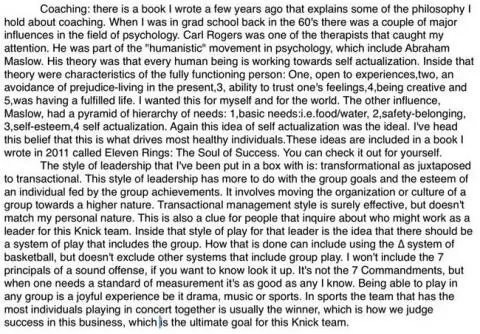
Phil Jackson released this message on Twitter after the release of head coach Derek Fisher.

When he refers to the seven principles of sound offense, you can read about those here and here.

Mr. Jackson also added these comments when speaking to the NY Daily News: “Someone has to match the style about the way we do things,” he said. “And there’s a certain style that I have that I think that works and have found to work before. I don’t know if all those people measure up to that because I don’t know them enough. But that’s an important aspect to it. We’ll find that type of person.”

Charley Rosen, a longtime close friend of Phil Jackson’s, tells what he knows about Derek Fisher’s firing and Kurt Rambis.

Note: This code is currently a work in progress. I know of possible approaches, but I don’t know of a perfect working solution yet.

I’m currently trying to find the right way to find the current monitor size, when you’re writing a Java Swing application to work in a multiple-monitor configuration. I always use three monitors, so I can test this pretty easily.

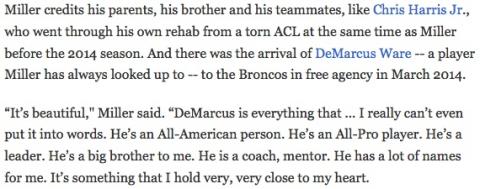
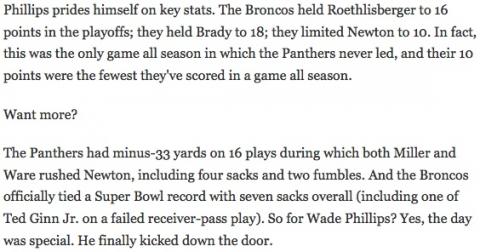
If you’ve never heard him speak, DeMarcus Ware seems like a truly great guy, a real leader and team-builder. I suspect he’s one of the quiet MVPs behind the Denver Broncos Super Bowl championship.

(Image comes from this espn.com page.)

As a quick note, if you ever need to use a Java TimerTask, you can define one like this:

class BrightnessTimerTask extends TimerTask {
    @Override
    public void run() {
        // your custom code here ...
    }        
}

and you can then instantiate it, create a Timer, and schedule the task like this:

I like to listen to audiobooks when I drive around the country, and on my last drive back and forth to New Mexico I listened to the Pema Chodron audiobook, When Pain is the Doorway.

At some point in the book she talks about the storylines that constantly run around in our heads. I can’t remember if she was talking about a specific painful experience or just about storylines in general, but when I got to my hotel I made these notes about what she said: “Go beneath the story ... that takes a while, and meditation is the tool for that, to let go of inner dialog and come back to the direct experience.”

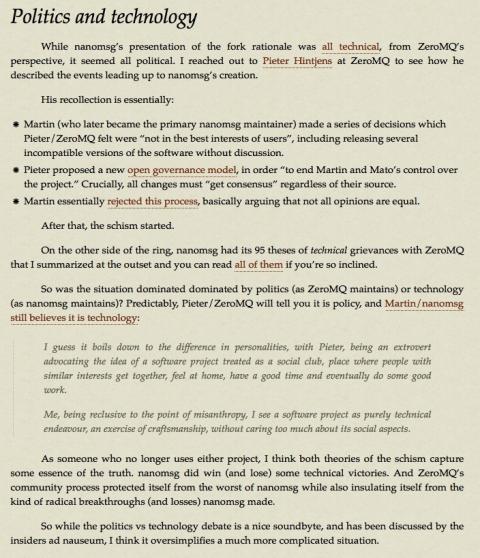
This blog post titled nanomsg postmortem and other stories is so good I wanted to share this part of it on “politics and technology.” The whole thing is a great read, as is this other article titled Requiem for Nanomsg. Both articles tell a fascinating story about software development, “politics,” and leadership.

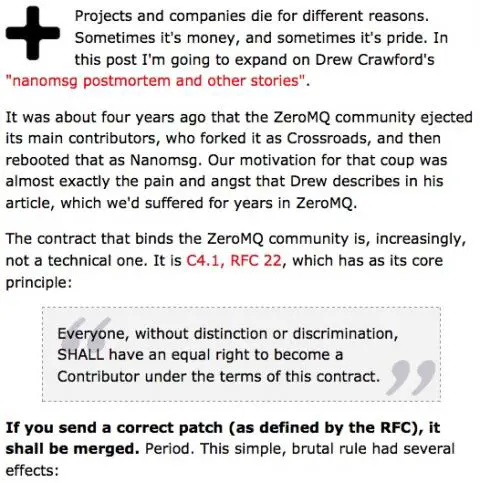
This image is from a great blog post titled Requiem for Nanomsg. If you’re interested in the “social development of software,” aka, open source software, that post and this earlier post titled nanomsg postmortem and other stories are both excellent reads.

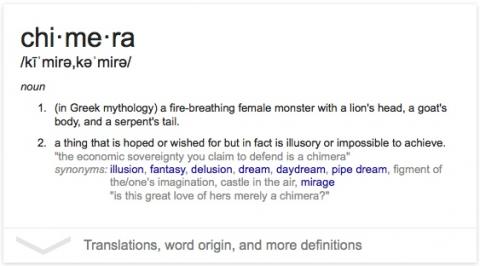
I saw someone use the word “chimera” a few days ago. I had a ballpark idea of what it meant, but here’s the precise definition, courtesy of the Google search results. The second definition is about what I had in mind.

All season long I watched the Denver Broncos team, and especially their defense, and wondered if they could keep doing it. In Super Bowl 50 they answered that question with a, “Yes we can.” Amazing. Congratulations.

The image comes from this espn.com page.)

Sadly, I had to get away from Scala for a while, but now I can get back to it again. Just as I started getting back into it I happened upon the following code, and thought, “Well, surely title in this anonymous class is a var field. How strange that the Programming in Scala guys would use a var like this.”:

I created this “cartoon” image using Gimp. If you can imagine starting with an ordinary wedding photo, that’s what I started with on this image. Then I messed with the colors a little bit, then used the “Cartoonize” plugin, then did a Gaussian Blur on the background a couple of times. I probably did some other things, but that’s what I can remember doing. (FWIW, I’m the tall one in the middle.)

To be clear, the “Cartoonize” effect is a Gimp plugin. It does not come with the standard Gimp installation.

Until a little while ago I don’t think I had ever thought about intentionally casting a null value in Java, but then I ran into a problem and realized that the solution was to cast a null value, like this:

FileDialog d = new FileDialog((java.awt.Frame) null);

You have to do that in this case because FileDialog has several one-argument constructors, including one that takes a JFrame and another that takes a JDialog. If you just put null in the constructor the Java compiler or your favorite IDE will complain, so you have to cast the null value to one of those specific types, and this syntax shows how to do this. (My app uses multiple frames, and at the moment I’d rather put null in the FileDialog constructor than try to determine which frame is currently in the foreground.)