Scala, Java, Unix, MacOS tutorials (page 256)

I was just reminded that functions are values just like Int, String, etc. Beyond the “typical” use cases, this is also true when it comes to supplying a default value for a function parameter that you’re passing into a method.

As some quick background, as I showed in the Scala Cookbook, you can define a method that provides default values for one or more of its parameters like this:

This quote is from San Antonio Spurs’ head coach Gregg Popovich. I know the feeling.

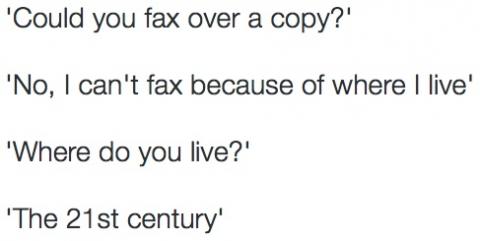
I run into this at least once or twice a year, and it drives me crazy that people still require you to use fax machines. I don’t mind a fax as an option, but for some businesses like pharmacies, doctors, rental agencies, and financial institutions, it’s how they operate. (Image is from this Twitter post.)

Over the course of a few hours this past week I created a little “scratchpad” text editor I named AlPad. It’s gone through several names, but since I’m just writing it for me, the name seems appropriate.

It’s not really correct to call AlPad an “editor”; it’s really just an app where I can keep a collection of miscellaneous notes I usually make when I’m working. It has very few features, just some ones I want and can implement easily:

I just got this in the mail. A local town is having a “cookie exchange,” and being something of a cookie connoisseur, I may have to check this out.

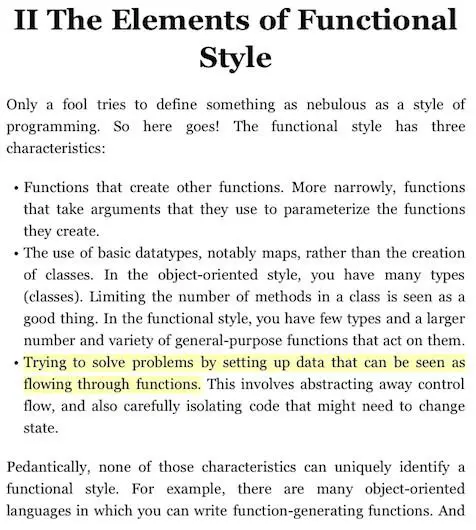
This image is from the book, Functional Programming for the Object-Oriented Programmer. It provides a good, basic definition of functional programming.

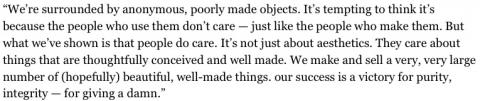
“People care about things that are thoughtfully conceived and well made ... our success is a victory for purity, integrity -- for giving a damn.” ~ Jonathan Ive, Apple

Wow, I have to say, I’ve never gotten out of an airplane to push it when it was 58 degrees below zero.

I learned about jq yesterday. As their web page says, “jq is like sed for JSON data – you can use it to slice and filter and map and transform structured data with the same ease that sed, awk, grep and friends let you play with text.” (I learned about it via this tweet by Grzegorz Kossakowski, who I met at the Scala Summit in 2013.

Wow, I was just informed that the Scala Cookbook is still an O’Reilly bestseller. That’s cool.

I’ve been developing a new Scala application named Cato that requires some command-line parameters, and I just had to figure out how to configure Eclipse so my application would get those parameters. Doing this with Scala in Eclipse is different than configuring Java command line parameters in Eclipse, so I thought I’d share the recipe.

Fortunately it’s just a two-step process. First, click the drop-down icon next to the “Run” button and choose “Run Configurations”, as shown here:

Argot is the name of a Scala library that lets you read command-line options/arguments from a Scala application. (Presumably it will work with Java and other JVM-based languages as well.)

I’m trying to use Argot with an application of mine named Cato, and when I had problems getting Argot to work -- and then needed to pass command-line arguments to my application through SBT -- I decided to write this quick little test code and article.

(Introductory note: In the story that follows, the word “gate” is pronounced “gah-tay”.)

I was intently digging through the bananas in the grocery story, trying to find some that were to my liking, when I heard a woman’s voice say, “Excuse me, do you mind if I ask what that song is that you’re humming? It sounds familiar, but I can’t place it.”

I haven’t figured out where one town ends and the next begins around here, but this is a field of prairie dogs I saw while on a walk last week in either Broomfield or Louisville, Colorado. (The snow is gone this week. It usually doesn’t last very long.)

A field of prairie dogs in Broomfield or Louisville, Colorado

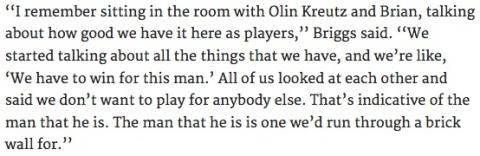
A few Chicago Bears players talking about former head coach Lovie Smith, including the phrase, “Win for this man.”

As an experiment — that’s a big emphasis on the word “experiment” there — I decided to create an @impure annotation for my current Scala project. The annotation is a “do nothing” annotation, so it doesn’t actually check the code in the way the @tailrec annotation works, for example.

If I can’t tell it’s Monday morning any other way, I always know it as soon as I go to check my email. Whatever they do on Sunday night or Monday morning, it almost always results in down time.