
I started shopping for Christmas a few weeks ago, so what the heck, here's a discount code for ThinkGeek:
Scala, Java, Unix, MacOS tutorials (page 297)
I’m sitting in the large back seat of a car with Columbo, Kojak, and the guy from Hawaii 5-0. We’re hungry, so Columbo is driving us to this restaurant he knows.
We take a right at a corner, and Columbo pulls forward about four parking spaces and parks the car. As he pulls through the empty parking spaces I see the pavement as though I’m a hood ornament on the car, looking down over the front of the car. I don’t wonder about that, but I do wonder why he didn’t take the first parking spot, which would have been closer to the restaurant, whose entrance is on the corner.
A great cartoon story on how to meet and interact with introverts: http://themetapicture.com/how-to-interact-with-the-introverted/

At six feet tall, I was pretty happy that I could dunk a tennis ball in high school. But I could not hurdle over a 6’5” teammate, even if he ducked a little.

I just put my Bose SoundLink speaker on sale at eBay. It has incredible sound, works over Bluetooth wireless, and is portable, running either while plugged in or on battery power. I love it, except for one thing: In my opinion, it has too much bass for my current apartment.

Sunset and moonrise over Anchorage, Alaska. From the Alaska Dispatch Facebook page.

A few days ago I shared the source code for a simple Akka remote actor example. In that example I showed how to communicate between actors in two different JVMs using Scala and Akka. In that example I showed how to communicate between the two JVMs using String messages because I didn’t want to make the example any harder than necessary.
Today, I’m taking that example just one step further to show how to communicate between actors on different JVMs by using custom objects for your messages.

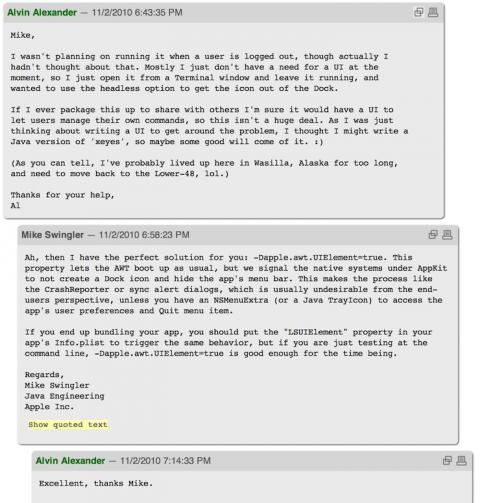
A funny thing about using AppleScript with Java -- and three years later with Scala and Akka -- is that you tend to run into the same errors. So glad this URL kept a transcript of my earlier problem ("Problems running AppleScript with Java headless argument"), the solution of which is shown in this image. The conversation was also logged in a less convenient format here.

I saw a Scala method recently that was written like this:
def abs (i: Int): Int = {
    if (i < 0) -i
    else i
}
There’s nothing wrong with this method, especially if you’re new to Scala. The method does one thing, and it’s very readable. However, it’s important to know that you can do a number of things to simplify the method, and by the time you’re done with the simplifications it will be easier to read.
I don’t remember where I first saw this, but I just ran across it yesterday.

I like this stuff, in part because I like spinach, but mostly because it sounds like Klingon food.