


I went through this several times when writing the Scala Cookbook and Functional Programming, Simplified. In the end I just tried to think of myself, and write a book that would have been helpful to me five years earlier. (Image from this Twitter page.)
Scala, Java, Unix, MacOS tutorials (page 138)
| A Machine Learning Bestseller | |
|
Introduction to Machine Learning with Python |

Lost in the recent announcement about JPMorgan Chase, Amazon, and Berkshire Hathaway combining forces to get into the employee insurance business is the fact that they are already self-insured employers. I read that in this Business Insider article, where I also read that 80% of large companies are already self-insured.
This short blog post contains a collection of Scala number and date examples. I created most of these in the process of writing the Scala Cookbook. Unlike the Cookbook, I don’t describe the examples here much at all, I just show the examples, mostly as a reference for myself (and anyone else that can benefit from them).
Scala numeric types
Scala has these numeric types:
[toc hidden:1]
Objective judgment, now at this very moment.
Unselfish action, now at this very moment.
Willing acceptance — now at this very moment — of all external events.
That’s all you need.
~ Marcus Aurelius (as seen in the book, The Obstacle is the Way)
If you’re into understanding business financial statements and/or interested in investing, I’ve been reading Warren Buffett and the Interpretation of Financial Statements for the last week or so, and I can confirm that it’s a good book for non-experts like me. With just a few exceptions, all of the terms you’ll encounter on income statements, balance sheets, and cash flow statements are explained simply and easily.
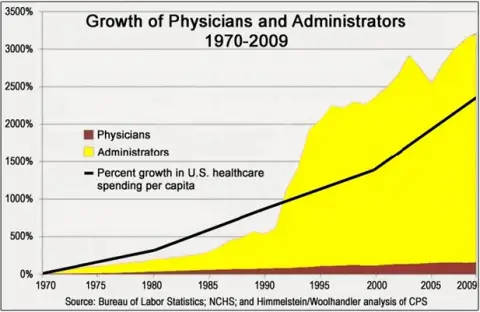
I was just reading a Seeking Alpha article about the pending healthcare deal between Berkshire-Hathaway, Amazon, and JPMorgan/Chase, and someone who added a comment referred to this image about the rising costs of healthcare in the United States, and how those costs correlate not to an increase in physicians, but to an increase in administrative overhead. (The image comes from this IBJ.com page.)
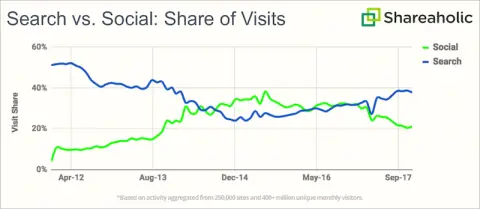
I was just reading this Seeking Alpha article about Facebook and saw the attached image, where for a while “link sharing” on sites like Twitter, Facebook, and Pinterest overtook search engines in terms of “share of website visits,” but in 2017 search engines once again overtook sharing. The question is, does this mean that fewer people are using those social websites, or fewer people are sharing and clicking on those links?
If a child lives with criticism,
he learns to condemn.
If a child lives with fear,
he learns to be apprehensive.
If a child lives with ridicule,
he learns to be shy.
If a child lives with shame,
he learns to feel guilty.
If a child lives with encouragement,
he learns to be confident.
If a child lives with praise,
he learns to be appreciative.
If a child lives with acceptance,
he learns to love.
If a child lives with approval,
he learns to like himself.
If a child lives with honesty and fairness,
he learns what truth and justice are.
If a child lives with friendliness,
he learns that the world is a nice place in which to live.
With what is your child living?
~part of a "Children Learn What They Live" poem by Dorothy Law Nolte
This medium.com article has some good, simple tips on how to improve your UI design. Also, this eloquentjavascript.net website/book might be good for people interested in JavaScript.
ARK Invest has a good article, “Why has Waymo taken so long to commercialize autonomous taxis?,” in which they write about System Identified Failures and Unexpected Failures.
One interesting note from the article that has nothing to do with Waymo: “Some stretches of road are trickier and some intersections more difficult to navigate than others. In Los Angeles, for example, roughly a quarter of pedestrian collisions take place at only 1% of its intersections.”
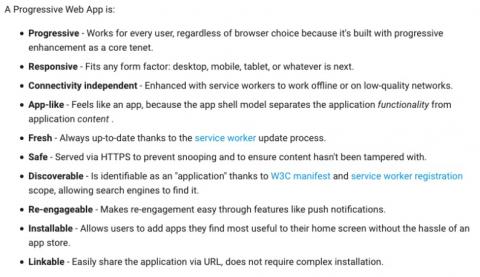
Google has some good resources on Progressive Web Apps (PWA), including this Your First Progressive Web App tutorial.
FYI: The price of the “Hello, Scala” Kindle ebook will be going up to $9.99 on March 1, 2018.
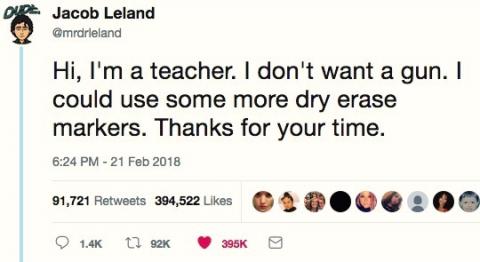
Sadly it had to come because of yet another senseless tragedy, but I’m glad to see students and teachers standing up to the NRA and NRA-bought politicians. This image shows a brilliant tweet from a teacher.
It can be harder to ice skate in Alaska than you might expect. This is the ice in the Turnagain Arm area, which is south of Anchorage, on the way to Alyeska, Seward, and Homer. (There are some very nice places to ice skate, but this isn’t one of them.)

“Oh, my goodness. You know sometimes I think that God gave you such a big heart that he just left no room for plain sense.”
~ a favorite quote from a favorite tv show
Way back in 2013 — before my first fake heart attack followed by learning that I had thyroid cancer — I thought I was about to go “back to work”, and I decided to try to write another visual demo of Akka Actors before I went back to work. I gave myself 10 hours to write something, and at first I decided to just create some bubbles that would move about randomly on screen. But I got that working so fast that I decided to do something else.
Eventually I came up with the idea of a little “kill the bubbles” game, which turned into a “kill the characters” game. This video shows how it works:
I went to the library and asked for a book on Pavlov’s dog and Schrodinger’s cat. The librarian said it rang a bell but she didn’t know if it was there or not.
~ nerd humor (from multiple sources)
I’m only about fifty pages into the book, How Google Works, but I can already say that if you think of yourself as an entrepreneur, it’s a valuable read. At first I thought the authors were patting themselves on the back a lot (which admittedly they deserve), but as I continued reading they clearly say things like “We’re not that smart,” “We screwed up,” and “Learning from our mistakes, this is why we created Alphabet.”
Some of their ideas, such as building businesses around their smartest people and greatest assets are things that I did in the past, but couldn’t articulate. Maybe it had to do with being in Kentucky at the time, but I always thought of it as “Get out of the way and let the thoroughbreds run.”
The Verge has two stories about Google, Android, and hardware. First, Google sold 3.9 million phones in 2017, increasing their market share from 1.8 to 2.8%. Second, they have a good interview with Rick Osterloh about Google’s hardware plans.
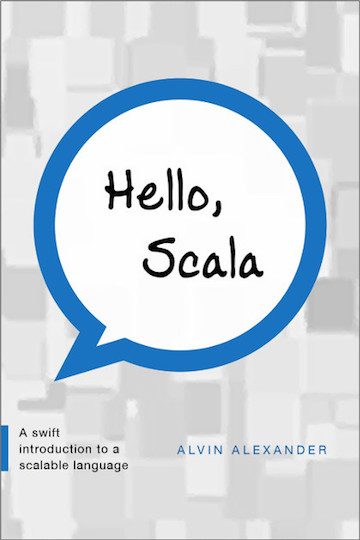
I wrote the Scala Cookbook for programmers looking for solutions to common Scala problems, and then wrote Functional Programming, Simplified for programmers looking for a simple way to learn functional programming. A few months ago I decided to finish my Scala trilogy and write a book for programmers who don’t know Scala and want a quick introduction to it. With that, Hello, Scala was born:
| A Machine Learning Bestseller | |
|
|
Introduction to Machine Learning with Python |