


The Blues Brothers, starring Dan Akroyd and Jim Belushi, are on a little road tour. If I’m healthy enough by November, it would be great to travel to see them. It would be even greater if they’d play a show in Colorado. ;)
Scala, Java, Unix, MacOS tutorials (page 189)
| A Microservices Bestseller! | |
|
Building Microservices |

“C wears well with experience” ~ a quote from the classic book, The C Programming Language.
(I like to think that well-written Scala code wears well with experience.)

Seibel: What do you enjoy about programming?
Peyton Jones: For me, part of what makes programming fun is trying to write programs that have an intellectual integrity to them ... so I think a good attribute of a good programmer is they try to find a beautiful solution.
(A quote from the book, Coders at Work)
“As soon as you start programming with side effects, evaluation order becomes important.”
From the book, Masterminds of Programming: Conversations with the Creators of Major Programming Languages
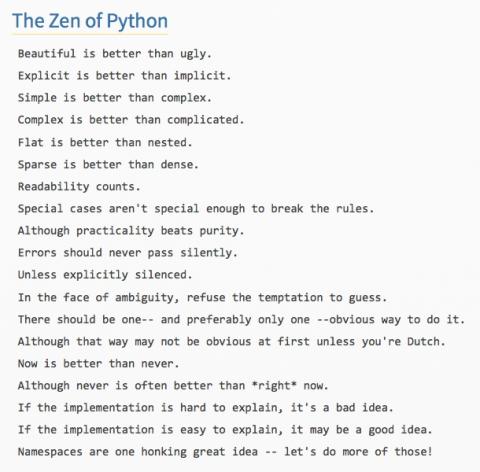
From the python.org website: “Long time Pythoneer Tim Peters succinctly channels the BDFL's guiding principles for Python's design into 20 aphorisms, only 19 of which have been written down.”
1995: [at blockbuster] yes, please call me when the movie I want is returned
2016: [netflix won’t load] I've never endured such suffering
(from this twitter page)
The first seven chapters of my new book, Functional Programming, Simplified, are now available online. More coming soon.
As a “note to self,” I just updated this Drupal 8 website in less than three minutes. Actually, what I did was (a) test the Drupal update on a Test server, and then (b) did the update here in less than three minutes.
The following block shows my Cliffnotes on performing the update. If you’re familiar with Drupal, these notes may make sense, and help you when you need to perform an update of your own.
UPDATE: Once you get to a certain level of Drupal — I don’t remember the exact version but somewhere around 8.43 or 8.5 — you shouldn’t use Drush to update your website any more, you should use Composer. I write about this in my article, A Drush 9 list of commands for Drupal 8.
Update Drupal 8.1.3 to 8.1.8 (Test Server)
Update Drupal 8.1.3 to 8.1.8 (on the test server)
=================================================

# create a new database on my test server
mysql -u root -p
create database aad8prod;
use aad8prod;

# create a mysql user and grant permissions
GRANT ALL PRIVILEGES
ON aad8prod.*
TO 'prod_user'@'localhost'
IDENTIFIED BY 'prod_password'
WITH GRANT OPTION;


# restore the production database to my test server
source aa.com.sql.20160814;


# update the drupal8 config with the new username and password
# sites/default/settings.php
$databases['default']['default'] = array (
  'database' => 'aad8prod',
  'username' => 'prod_user',
  'password' => 'prod_password',
  'prefix' => '',
  'host' => 'localhost',
  'port' => '3306',
  'namespace' => 'Drupal\\Core\\Database\\Driver\\mysql',
  'driver' => 'mysql',
);


# Test server notes

- had to disable the 'trusted_host_patterns' in settings.php
- drupal error message was:
  The provided host name is not valid for this server.
- made sure everything is working on the test server
- i turn off my wifi to make sure i don't accidentally do
  something on the prod server
Performing the Drupal Update (Test server)
Performing the Drupal Update (Test server)
------------------------------------------

# download latest drupal version (8.1.8)

- unpack it
- follow the instructions in /core/UPDATE.txt:
  - MINOR AND PATCH VERSION UPDATES
  - if needed, make a backup copy of your settings.php file
  - backup .htaccess and robots.txt
      - cp settings.php settings.php.pre20160814  (sites/default)
      - cp .htaccess .htaccess.pre20160814
      - cp robots.txt robots.txt.pre20160814
  - unpack drupal update files somewhere so you can quickly and easily
    copy them after you remove the old files
        - in this case i put mine in:
            - ../drupal-8.1.8
  - take the website offline
      - admin/config/development/maintenance
  - cd to the drupal8 root directory
  - `drush cr`
      - my cache database tables are several GB; flush them
  - rm -rf core vendor
  - rm *php
  - rm composer*
  - rm web.config
  - unpack new files
      - cp -R ../drupal-8.1.8/* ../drupal-8.1.8/.htaccess .
  - run update.php via browser
      - http://aad8:8888/update.php
      - this shows an update page with no css
          - 'tmp' directory on Test server was messed up
  - check that everything is working
  - go back online
      - admin/config/development/maintenance
Potential Test Server problems
"Couldn't write file" error message (Test server)
-------------------------------------------------

- looked in reports
- may have to do with:
    - couldn't write .htaccess file
    - couldn't use temporary directory b/c it was looking for
      the temp directory i use in production
    - change the temporary directory at this uri:
        - admin/config/media/file-system
            - change to: /Applications/MAMP/htdocs/aad8-drupal-tmp
    - the css/html is screwed up on this page:
        - admin/reports/dblog
        - `drush cr` fixes this
Production Server
Production Server
=================

- after i confirmed that the update didn't clobber my website,
    i followed the same steps on the Production server
- investigate the differences between these files:
    - .htaccess
    - robots.txt
Those notes are cryptic, but if you need an example of the steps needed to update a Drupal 8 website from one minor version to another (in just a few minutes on the Production server), I hope they are helpful.
I hear a lot of people say they want to be successful. For me this always comes down to, “What are you willing to do to make that happen?”
In my own case I had to overcome a fear of public speaking, learn how to write software, learn how to build and manage a company, learn some sales techniques, make sacrifices on how I spend my time, etc.
“Adam is just special. He has that kind of makeup that is always trying to invest in other people.”
~ Cardinals’ manager Mike Matheny talking about Adam Wainwright
As a quick note to self, this source code from the online version of Learn You a Haskell shows how to read command line arguments in Haskell:
-- from "Learn You a Haskell"
-- http://learnyouahaskell.com/input-and-output

import System.Environment
import Data.List

main = do
    args <- getArgs                  -- IO [String]
    progName <- getProgName          -- IO String
    putStrLn "The arguments are:"
    mapM putStrLn args
    putStrLn "The program name is:"
    putStrLn progName
If you save that source code in a file named args.hs, and then compile it with ghc like this:
ghc args.sh
you can test it with no command line args like this:
$ ./args
The arguments are:
The program name is:
CommandLineArgs
and then give it a few test command line args like this:
$ ./args foo bar
The arguments are:
foo
bar
The program name is:
CommandLineArgs
As I show in the comments that I added, getArgs has the type IO [String], and progName has the type IO String.
I want to try writing a few simple scripts/programs in Haskell, so hopefully over time I’ll add more information on how to process command line arguments in Haskell. Until then, the Learn You a Haskell link I shared at the beginning has good information on handling I/O in Haskell.
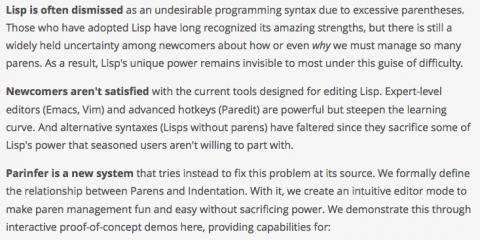
Parinfer is a tool that is currently in development, and it’s intended to help with the management of all those parentheses in languages like Lisp and Clojure. It looks like it is written in JavaScript, and intended to work with editors like Atom and Sublime Text.
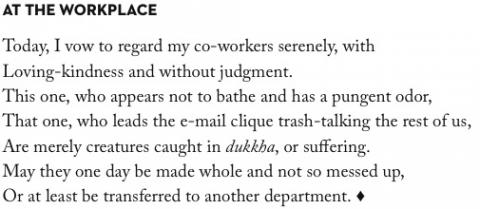
This image is from this New Yorker article on modern day mindfulness. This is a “poem” about mindfulness at the workplace.
Many Olympic athletes are using the ancient Chinese practice of cupping to promote healing, but the Greek team has their own technique.
(Half of my DNA comes form the Middle East, so, you know.)

In this post I share the contents of a custom TextMate command I just created that uses pandoc and sed to convert markdown content in the TextMate editor to a “pretty printer” version of HTML:
#!/bin/sh

PATH=$PATH:/usr/local/bin

# note: 'sed -E' gives you the advanced regex's

# use pandoc to convert from markdown to html,
# then use sed to clean up the resulting html
pandoc -f markdown -t html |\
sed -Ee "/<p|<h2|<h3|<h4|<aside|<div|<ul|<ol/i\\
\\"
You can try to use a command like tidy to clean the HTML, but the version of tidy I have does not know about HTML5 tags. The TextMate Markdown plugin also doesn’t work the way I want it. Besides that, I’m trying to learn more about writing TextMate commands anyway.
As an important note, when you set this up as a TextMate command and then run it, it will convert the TextMate editor contents from markdown to HTML.
(In a related note, serenity.de is also a good resource for TextMate command and bundle documentation.)
In summary, this code shows:
* How to execute a Unix shell command from TextMate
* Specifically, how to execute a sed command from TextMate
* How to use modern regular expressions with sed (the -E option)
* How to search for multiple regex search patterns with sed
As a little tip today, here’s a short Java/JDBC example program where I show how to perform SQL SELECT, INSERT, UPDATE, and DELETE statements with JDBC:
package com.devdaily.sqlprocessortests;

import java.sql.*;

public class BasicJDBCDemo
{
  Connection conn;

  public static void main(String[] args)
  {
    new BasicJDBCDemo();
  }

  public BasicJDBCDemo()
  {
    try
    {
      Class.forName("com.mysql.jdbc.Driver").newInstance();
      String url = "jdbc:mysql://localhost/coffeebreak";
      conn = DriverManager.getConnection(url, "username", "password");
      doTests();
      conn.close();
    }
    catch (ClassNotFoundException ex) {System.err.println(ex.getMessage());}
    catch (IllegalAccessException ex) {System.err.println(ex.getMessage());}
    catch (InstantiationException ex) {System.err.println(ex.getMessage());}
    catch (SQLException ex)           {System.err.println(ex.getMessage());}
  }

  private void doTests()
  {
    doSelectTest();

    doInsertTest();  doSelectTest();
    doUpdateTest();  doSelectTest();
    doDeleteTest();  doSelectTest();
  }

  private void doSelectTest()
  {
    System.out.println("[OUTPUT FROM SELECT]");
    String query = "SELECT COF_NAME, PRICE FROM COFFEES";
    try
    {
      Statement st = conn.createStatement();
      ResultSet rs = st.executeQuery(query);
      while (rs.next())
      {
        String s = rs.getString("COF_NAME");
        float n = rs.getFloat("PRICE");
        System.out.println(s + "   " + n);
      }
    }
    catch (SQLException ex)
    {
      System.err.println(ex.getMessage());
    }
  }

  private void doInsertTest()
  {
    System.out.print("\n[Performing INSERT] ... ");
    try
    {
      Statement st = conn.createStatement();
      st.executeUpdate("INSERT INTO COFFEES " +
                       "VALUES ('BREAKFAST BLEND', 200, 7.99, 0, 0)");
    }
    catch (SQLException ex)
    {
      System.err.println(ex.getMessage());
    }
  }

  private void doUpdateTest()
  {
    System.out.print("\n[Performing UPDATE] ... ");
    try
    {
      Statement st = conn.createStatement();
      st.executeUpdate("UPDATE COFFEES SET PRICE=4.99 WHERE COF_NAME='BREAKFAST BLEND'");
    }
    catch (SQLException ex)
    {
      System.err.println(ex.getMessage());
    }
  }

  private void doDeleteTest()
  {
    System.out.print("\n[Performing DELETE] ... ");
    try
    {
      Statement st = conn.createStatement();
      st.executeUpdate("DELETE FROM COFFEES WHERE COF_NAME='BREAKFAST BLEND'");
    }
    catch (SQLException ex)
    {
      System.err.println(ex.getMessage());
    }
  }
}
This code is taken from this Simple JDBC Example on an older version of my website. I’m including it here so I can search for it more easily.
The database that this code uses is the Coffee Break database from Sun’s original JDBC tutorial.
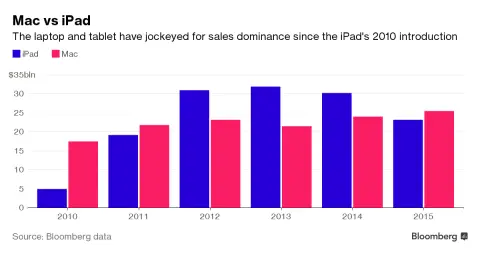
A Bloomberg report says that Apple is planning to release a new MacBook Pro that has a narrow OLED screen at the top of the keyboard, which may replace the function keys. In that same article they share this chart, which shows iPad sales compared to Mac sales (which presumably includes all MacBook, MacBook Pro, and Mac Pro models).
“In Erlang it’s OK to mutate state within an individual process but not for one process to tinker with the state of another process ... processes interact by one method, and one method only, by exchanging messages. Processes share no data with other processes. This is the reason why we can easily distribute Erlang programs over multicores or networks.”
Joe Armstrong, in the book Programming Erlang
Note: This is an excerpt from my book, Functional Programming, Simplified. (No one has reviewed this text yet. All mistakes are definitely my own.)
Defining “Functional Programming”
It’s surprisingly hard to find a consistent definition of functional programming. As just one example, some people say that functional programming (FP) is about writing pure functions — which is a good start — but then they add something else like, “The programming language must be lazy.” Really? Does a programming language really have to be lazy (non-strict) to be FP? (The correct answer is “no.”)
I share links to many definitions at the end of this lesson, but I think you can define FP with just two statements:
| A Microservices Bestseller! | |
|
|
Building Microservices |